Advances in phacoemulsification technology have substantially expanded surgeons’ ability to tailor fluidics, energy delivery, and efficiency during cataract surgery. Contemporary platforms incorporate increasingly sophisticated pump systems and software that allow surgeons to adjust vacuum dynamics and aspiration behavior to match surgical steps and nuclear characteristics. Among the most consequential design considerations is the choice of fluidics, particularly the use of peristaltic and Venturi vacuum systems, each offering distinct advantages in terms of chamber stability, occlusion control, and fragment followability. Modern systems that integrate both approaches provide surgeons with the flexibility to transition between fluidic modes during surgery, optimizing safety and efficiency throughout the different phases of phacoemulsification.
Veritas Clinical Performance
- Surgeons rated their overall satisfaction with anterior chamber stability and responsiveness of fluidics a 4.9 out of 5.0.
- 72% of surgeons rated the Veritas Vision System as better or much better than their current phaco system.
- 73% of surgeons rated their efficiency with Veritas Vision System as better or much better than with their current phaco system.
- 23% less post-occlusion surge compared to WhiteStar Signature Pro.
Source: Johnson & Johnson Vision
Dual-pump fluidics for cataract surgery are useful in cataract surgery because they enable more efficient removal. I use the Veritas Vision System (Johnson & Johnson) to switch back and forth on the fly between peristaltic and Venturi pumps. The peristaltic pump offers the highest vacuum and great stability, but it requires occlusion of the tip with nuclear material to build sufficient pressure. By contrast, the Venturi pump will create vacuum without occlusion, so I can hold my phaco tip centrally, staying in what I call the “zone of safety”—equidistant from the iris, cornea, and lens capsule—and let nuclear material come to the tip. I find this to be a very safe way of performing surgery because there is minimal movement of the phaco tip.
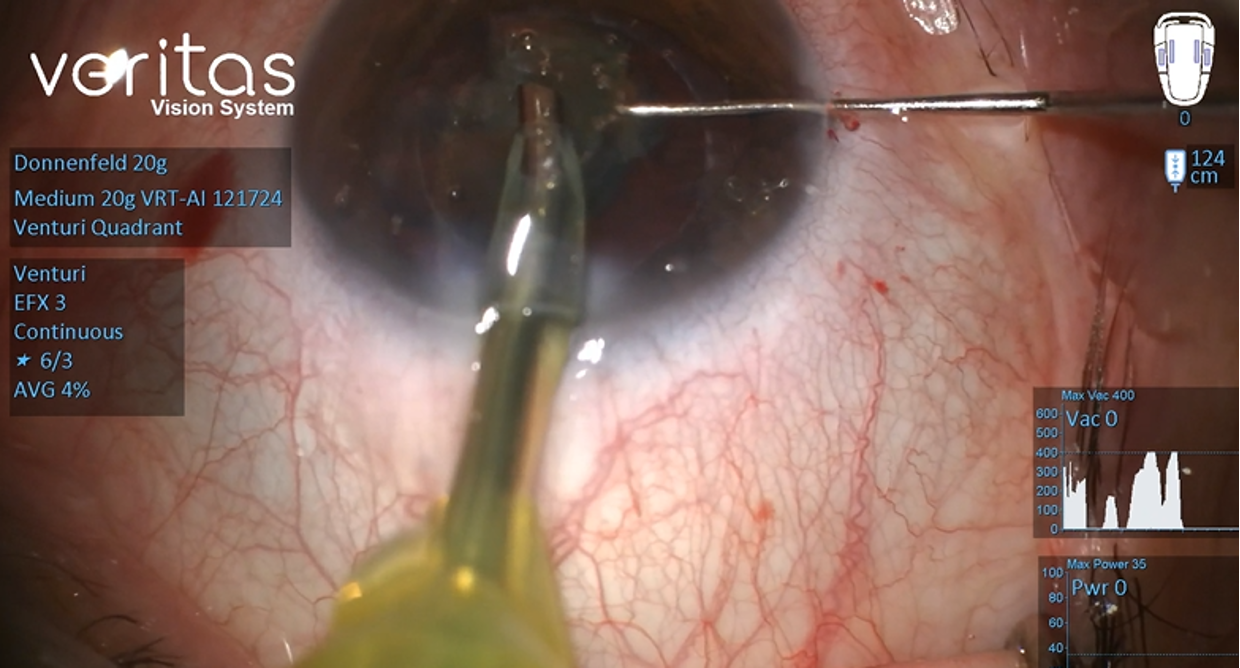
I begin most cataract surgery cases in peristaltic mode, removing the superficial viscoelastic from the lens and then sculpting grooves in the nucleus under low vacuum. After splitting the lens into quadrants, I begin phacoemulsification of the first quadrant with high vacuum in peristaltic mode. As soon as the first quadrant has been removed, I switch to Venturi mode for the rest of the nucleus removal and remove all the other fragments. The fluidics are so powerful that, in eyes with mild to moderate nuclear density, I can often remove the fragments with zero phaco power (Figure 1), leading to very clear corneas and rapid postoperative visual recovery. I’m able to use no power at all in about 75% of my femtosecond laser-assisted cases and maybe one third or more of my conventional cases.
Once I have removed most of the nuclear material, I switch to I/A mode with the Venturi pump. The powerful Venturi vacuum allows me to find and efficiently remove any sequestered viscoelastic or tiny nuclear fragments. I find that the Venturi pump particularly increases efficiency in femtosecond laser-assisted cataract surgery cases, when the nucleus has been pre-fragmented by the laser and there are lots of very small fragments. In such cases, the ability to switch to Venturi on demand, without switching phaco packs, significantly reduces my phaco time and total case time.
Fluidics Updates
Johnson & Johnson has recently updated the fluidics of the Veritas system. Changes include increased robustness in Venturi mode for better flow dynamics and a refined aspiration path to minimize obstruction and clogging with the Advanced Infusion (AI) Pack. The advanced tubing system has a thick, flexible outer layer for ease of maneuverability, but a thin, rigid inner layer (Figure 2) that maintains the same diameter even at high vacuum settings. This design keeps the tube from collapsing, minimizing surge and improving chamber stability. The narrow inner diameter also reduces the flow rate, providing surgeons with excellent control over vacuum and minimizing any variability in fluid volume inside the eye. I don’t see any “bounce” or “trampolining” effect, and post-occlusion surge in peristaltic mode is minimized.

Just like the previous-generation phaco machine, the Veritas system incorporates WhiteStar pulse modulation technology to deliver optimal cavitation without increasing thermal energy, and relies on an elliptical tip movement to deliver a blend of transversal and longitudinal ultrasound that reduces lens chatter and turbulence. That allows me, again, to be a more efficient surgeon by reducing the overall energy to the eye. This system also has gas-forced or pressurized infusion, rather than gravity-based infusion. I find that the consistent level of pressure without raising or lowering the infusion bag enhances stability. I can effortlessly perform a 25-gauge pars plana anterior or posterior vitrectomy when needed, as well.
Getting Started
For anyone new to the Veritas system, I recommend starting out with lower vacuum pressure of about 400 mmHg in peristaltic mode to familiarize yourself with the machine safely. Once you are comfortable with the user interface and satisfied with the chamber stability, you can raise the vacuum level. I now set mine at about 550 mmHg—a higher vacuum level than I had ever previously employed for cataract surgery, which reduces phaco time. Once comfortable with the device, surgeons can feel confident in operating at higher vacuum settings.
In some sense, the power of a phaco machine is really in how it performs in more challenging cases. With normal nuclear cataracts, I typically start off at approximately 35% ultrasound power, but in the case of a truly rock-hard nucleus, I can increase the power as high as I want to with this system, making the surgery a little bit faster and easier. The cutting power of the tip facilitates cutting and removal of even the densest lenses .1
Conclusion
We are fortunate to have very advanced phaco systems available for cataract surgery. For me, customizability of the settings and superb fluidics control remain the most important characteristics of a phaco machine in my hands.
Reference
-
Nelson TK, Ricks RG, Cardenas IA, et al. Comparison of Ultrasound Energy Delivered to the Anterior Segment Across Different Phacoemulsification Surgical Platforms. Med Devices (Auckl). 2025;18:29-35. Published 2025 Jan 14. doi:10.2147/MDER.S493847